SysLinuxOS Boot and GRUB Boot Management
A guide to SysLinuxOS Boot 0.2.0: APT installation, default GRUB entry, the active boot menu, backgrounds and Plymouth.

A guide to SysLinuxOS Boot 0.2.0: APT installation, default GRUB entry, the active boot menu, backgrounds and Plymouth.
Restore GRUB from a live USB with SysLinuxOS Boot Repair: system analysis, BIOS and UEFI boot, LUKS partitions, Btrfs, and snapshots.
Set up syslinuxos-ring-conky and syslinuxos-conky-window to monitor CPU, memory, disks, and network activity on the SysLinuxOS desktop.
Explore SysLinuxOS 13.3 for system integrators: MATE and GNOME editions, integrated AI tools, and improvements to system recovery and networking.
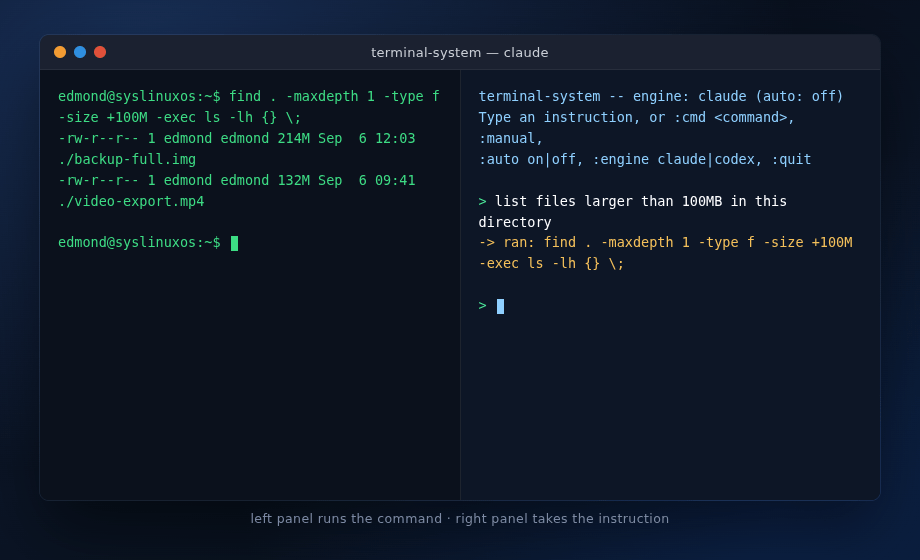
Use terminal-system with Claude Code or Codex to turn Linux administration requests into shell commands, with confirmation before execution.
SysLinuxOS – Snapshot Management Guide 1. Introduction SysLinuxOS 13.2 uses btrfs as its default filesystem and integrates snapper, grub-btrfs, and the syslinuxos-rollback helper to provide automatic, GRUB-bootable filesystem snapshots. Every time the system is updated or a snapshot is created manually, a copy of the root filesystem is stored in /.snapshots. These snapshots appear as boot entries in the… Leggi tutto »SysLinuxOS Snapshot Management Guide
SysLinuxOS 13.2 there was no more time This release is not a simple update, but it is the “14” version that I had in mind, a real epochal change. There was no more time and I didn’t want to wait any longer. SysLinuxOS 13.2 is a substantial revision of how the system handles storage, backups, recovery, and boot. The release… Leggi tutto »SysLinuxOS 13.2 Revolution
distroClone and distroClone-backup: A Complete System Protection Strategy for Debian-Based Distributions Anyone maintaining a customised GNU/Linux system eventually faces two distinct but related needs: a reliable backup to restore from in case of failure, and a bootable live ISO to deploy on new machines or preserve as a system snapshot. Until now, covering both scenarios required separate tools and manual… Leggi tutto »Guide to distroClone and distroClone-backup
DistroClone Backup & Restore In the development of SysLinuxOS, one recurring need was a reliable way to snapshot and restore a system quickly — not just for users, but also during testing and ISO development.That is how DistroClone Backup & Restore was born: a graphical, incremental backup tool designed specifically for Debian-based systems. It is the companion utility to DistroClone… Leggi tutto »DistroClone Backup & Restore
DistroClone Live ISO Builder is an open source tool that creates a bootable ISO image from any running Debian-based system, preserving the current configuration, installed packages, desktop theme, and user settings. The generated ISO includes the Calamares installer, allowing permanent installation on other machines.
